Pulling it together: on interoperability
Bridging the episteme-techne divide
On open and equitable research
I came back from Munich a few days ago, and I’m still processing it. It is this particular stirred-up feeling that stays with you after a gathering with a genuinely trying-to-think-it-through group: that of Open Research. It was convened by Sabina Leonelli and her Phil_OS group and hosted at the Institute for Advanced Study at the Technical University of Munich.
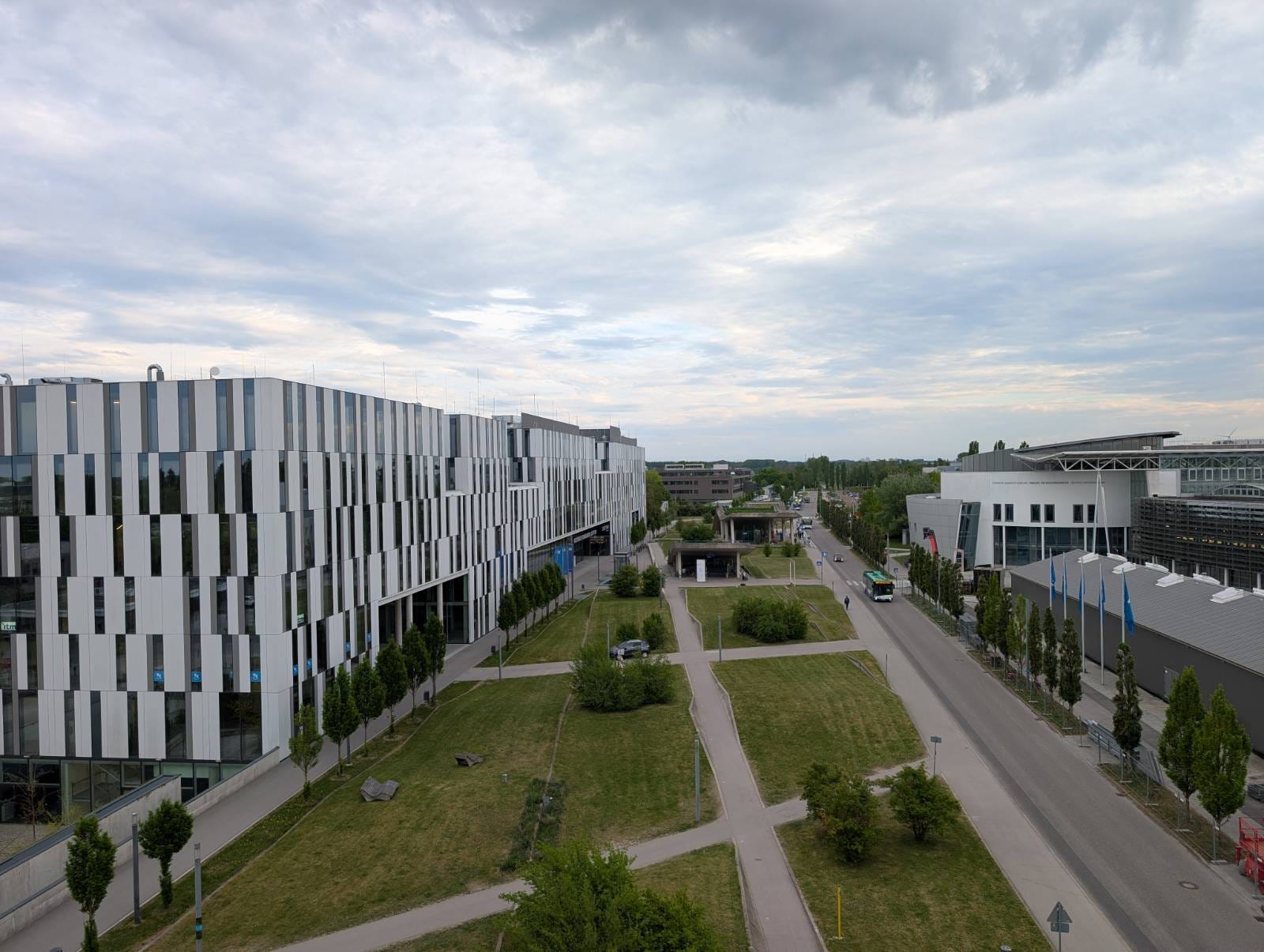
I arrived with some concerns about being overwhelmed by information, as the program looked very packed (with a topic marginal to me — policy of academic publishing — on top). But it turned out otherwise: I had a chance to get a picture of what is happening in the open research movement, particularly in the Munich hub (and in Vienna, Berlin, among other cities). This was perhaps one of the best curatorial works I’ve seen: computer scientists, social scientists, humanists, philosophers — all circling the same questions from different angles, and polite enough (converging philosophers from various traditions might be challenging :) ) to listen across the gaps.
Overall, as someone said in the final evening social event, what we had there was a nerdwork rather than a conference. That is, not networking in the transactional sense, but a slower, more honest thing that happens when researchers across disciplines share a problem they haven’t solved yet.
To highlight what Sabina said before one of the evening special presentations: open (and equitable) research, to succeed, needs wisdom and creativity. But also a kind of sensitivity to social context — a predisposition to see things from others’ perspectives, which is the very foundation of equity.
This coupling of wisdom, creativity, and social sensitivity points to something even deeper: the need to unite episteme and techne — knowledge and craft.
I will now unpack the points that stood out as particularly relevant from the conversations in Munich: first, the question of global infrastructure; and second, the three insights from the conference I found most meaningful.
The promise of (super)computing infrastructures
Before heading to Munich, I came across this interview in ISC’s newsfeed: “Are we building global knowledge infrastructure for the world we have or for the world we are trying to create?”
The question felt familiar, as it echoed debates I had followed closely during my short time in open knowledge / open education / open web, more than a decade ago. And it is both reassuring and inspiring to see that infrastructure is now in place alongside strong communities of practice.
It is a level of organising that, for example, much of the early open-source, creative-technologist community lacked. A glimpse of this organising and engagement was visible in Munich: students already working on EOSC issues, and, most inspiring of all, an emerging community forming around Health Data Spaces. We have all these top-down infrastructures that come as a promise: Data Spaces, EOSC. Some other, more costly (supercomputing power) and subsequent factories (giga and AI Factories) that recently came under scrutiny from both sides of the barricade. Yet, these dreams are not in vain. “Scale as you need” should be imperative (and we know there are times when scaling is needed). In a way, I’m hopeful these dreams can come to fruition with the right strategy.
This hope comes, in part, from personal experiences. I felt positive and optimistic after completing a data management training course at the Barcelona AI Factory hub two weeks ago. I went there with a short-term, pragmatic objective: to get to know the tools and repository I need to do my work as research support staff for a political science project at the University. Yet, the conversations that evolved as we tried to think through different pragmatic situations dealing with data collection — figuring out which principles to apply — highlighted that principles reflected as acronyms (FAIR, CARE, TRUST, and others to come), notions such as sensitive data, personal data, and the other promise — that of differential privacy — still need to be re-examined from a more fundamental background to effectively shape the internal structure of data.
When I have to put on my lenses as someone who looks at things from a philosophical perspective, I tend to say this: frameworks are merely the aperture, an open door that delimits the space of what is possible, but the structuring of that space remains an ongoing task.
Paradoxically, this ongoing task of thinking cannot be done without these pragmatic steps. It took me a while to realise. It was almost two years ago when my partner, Toni, suggested I look into the FAIR principles and data stewardship. So I went to a seminar on FAIR principles at BSC, which barely interpellated me. Then, months later, I decided to attend a data stewardship conference co-organised by CODATA. It was different, as finally, after many years, I could find myself again in a group talking about the semantic web and presenting technical challenges. What most caught my interest, though, was the conversation about defining FAIR Data Digital Objects (FDOs). It wasn’t agreement but rather perplexity, again: in philosophy in general and theory of knowledge in particular, we often refer only to objects.
Then, the final question addressed by Professor Carol Goble: “Do we mean the same by reproducibility in social sciences as in (natural) sciences?” together with Simon Houdson’s call to take on the task of figuring out what metadata descriptions are in the social sciences and humanities.
I carried on this task quietly, writing my almost-finished thesis manuscript, which seeks to shed some light on descriptive inference (often overshadowed by causal inference). In this process, I tried to engage even more deeply with the interesting article by Carole Goble, Paul Groth, and Stian Soiland-Reyes, and with the metaphor of two avenues — digital objects in the semantic web/linked data way and the FDOs — moving in the same direction: interoperability.
In parallel, I sometimes joined sessions organised by the Social Sciences and Humanities Lab at BSC that emerged after that conference. Some of the methods presented there have intersected with my work (such as Kaspar’s EnvironmentalScan), and others have informed it from a distance (David Garcia’s analysis of US congressional speeches using computational methods, which reveals a shift from evidence to intuition). Both are part of the methodology of the poster I presented in Munich (which I will describe in a next post). The poster centres the notion of concealment rather than openness.
Challenging openness — specifically when we will have to deal with sensitive data, personal data, etc. — was part of the central theme, and it is worth mentioning here the beta framework for thinking about the Open/Secret dynamic, presented by philosopher of science Helen Longino.
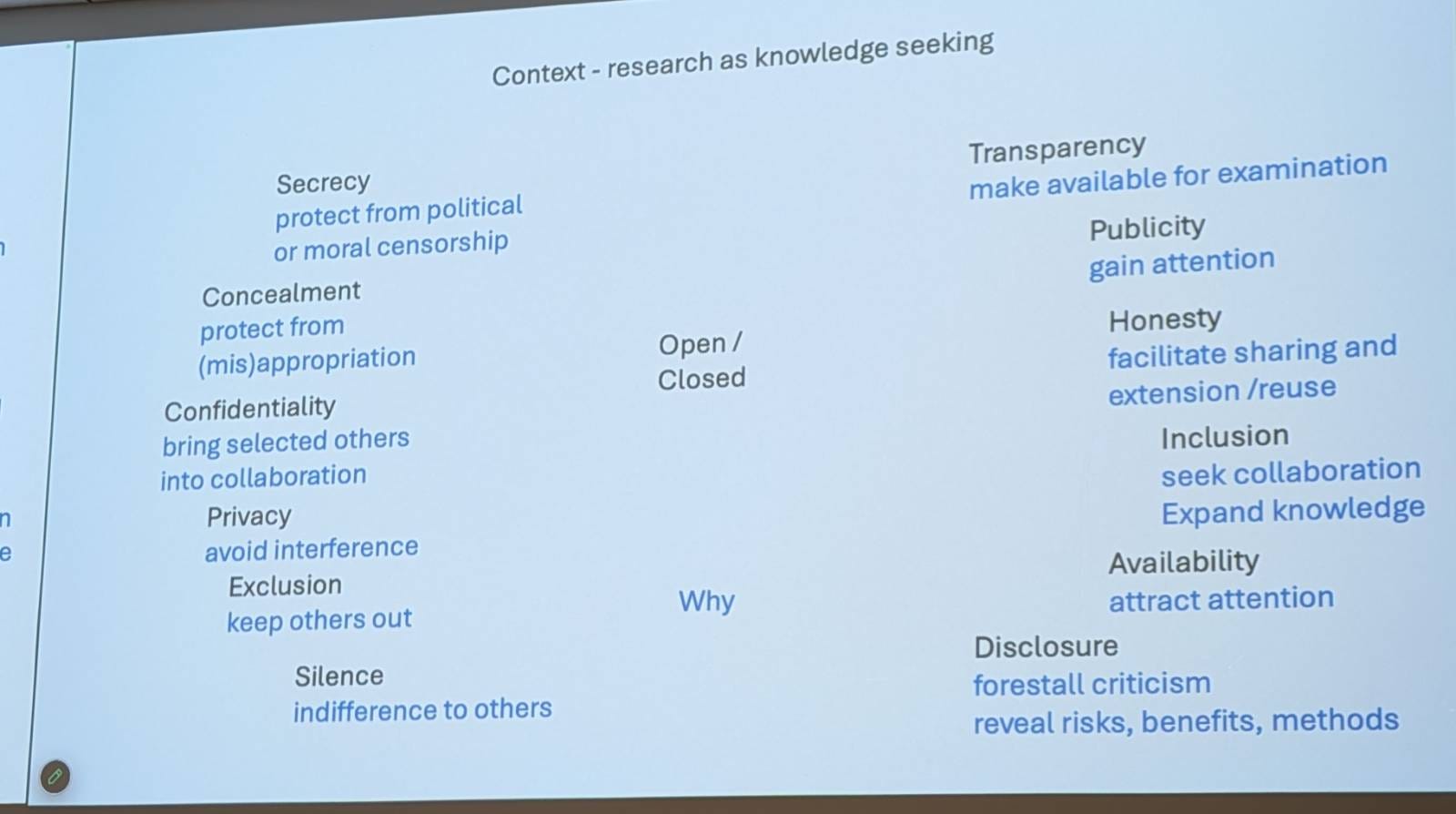
With the concept of context at its core, it offered a way to ask Why? — not as a rhetorical gesture but as a structuring one — without letting that question dissolve into abstraction. Context, here, is the condition that makes meaning possible at all.
Pulling it together
To pull together data interoperability, infrastructure collaboration, and governance compatibility, it does not take only communities of practice, infrastructures, open-source data repositories, and frameworks.
On one hand, it needs to bring more complex conversations to the table: as we move to data-intensive methods in the social sciences and the humanities, shall we see everything from the perspective of research data? What does it mean when the research question transitions towards an eidetic question (in a phenomenological sense)? How does this affect how we describe metadata? And many other questions that often don’t find their space in conventional events of the research data community. They are long-term and often have a restricted audience.
On the other hand, there is the involvement of the creative technologists community. Though open source is integral to open science, there are still transactions to be made (at least regarding ethos and attitudes).
FOR26 offered a glimpse of what this transaction might look like in practice. The gathering brought together not only researchers and infrastructure builders, but also people who carry a different kind of institutional memory — that of the open web, open source communities, and the creative technologist movements that preceded and, in many ways, anticipated the current moment in open science. I had the chance to meet in person Chris Hartgerink, with whom I share the Mozilla veterans tribe. He develops RadicalEquals, a tool to document and evaluate the research process. We talked about reflexivity, data citation, and more. Then, after the conference, I met with Tobi, MozVet and our ArtZilla creative champion, who showed me the creative innovation hub in Munich Ostbahnhof. We shared some good conversations on developing creative agents and bringing open tools to AI. This is an ongoing conversation that, as a growing group of MozVets, we’ve had over the last few months: how can we bring the spontaneity and creativity that shaped much of the open web as we lay the foundation for responsible AI? A conversation that sometimes raises philosophical questions but often ends up with demos.